
Seal holes in the heart without open-chest surgery. Dr. Anshu Kabra provides advanced, minimally invasive device closures for pediatric and adult congenital heart defects.
Conditions like ASD (Atrial Septal Defect), VSD (Ventricular Septal Defect), and PDA (Patent Ductus Arteriosus) cause oxygen-rich and oxygen-poor blood to mix. While some patients have no early symptoms, watch out for these signs in children and adults:
A distinct "whooshing" or "swishing" sound heard through a stethoscope during a routine exam, caused by turbulent blood flow through the defect.
In infants and children, congenital defects can cause severe exhaustion during feeding, leading to poor weight gain and stunted physical development.
Adults with an undiagnosed ASD or VSD may experience sudden breathlessness during exercise, chronic fatigue, or frequent lung infections.
In the past, repairing congenital heart defects required major open-heart surgery. Today, Dr. Kabra utilizes state-of-the-art interventional cardiology to permanently seal these holes using an advanced "umbrella-like" mesh device.
The device is delivered through a tiny puncture in the leg vein, entirely avoiding chest scars.
Over time, the heart's natural tissue grows over the mesh, sealing the defect for life.
Allows children and adults to return to normal, active lives within days.
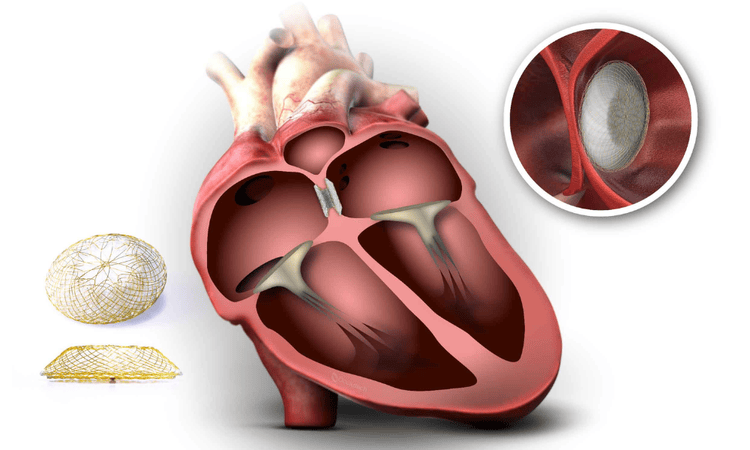
A minimally invasive, catheter-based technique to seal the defect permanently, without any surgical incision to the chest.
Dr. Kabra uses transesophageal echocardiography (TEE) to precisely measure the exact size, shape, and location of the ASD, VSD, or PDA to select the perfectly sized closure device.
While the patient is comfortably sedated or under anesthesia, a thin, flexible catheter is guided through a vein in the groin directly to the heart defect using real-time imaging.
The collapsed device is pushed through the catheter. Once across the hole, it springs open like a tiny umbrella, clamping securely onto both sides of the heart wall to instantly stop the abnormal blood flow.
Finding out our 6-year-old daughter had an ASD was our worst nightmare. The thought of opening her chest was unbearable. Dr. Kabra was so compassionate. He closed the hole using a catheter. She went home two days later with just a tiny bandage on her leg. We are forever grateful.
Understanding non-surgical treatment for congenital heart defects.
Ask Dr. Kabra DirectlyShare your details and our care coordinator will reach out within a few hours to schedule your assessment.